PROTEIN STRUCTURES & FUNCTIONS
FUNCTIONS Proteins function as: 1. Enzymes:biological catalysts 2. Regulators of catalysis-hormones 3. Transport and store  i.e.  O2, metal  ions sugars, lipids, etc.
FUNCTIONS 4. Contractile assemblies Muscle fibers 5. Sensory Rhodopsin nerve proteins 6. Cellular defense (antibodies/Ig) 7. Structural (collagen)
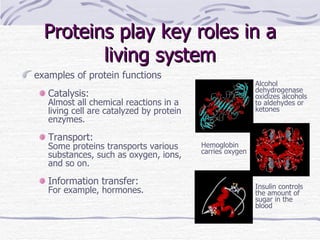
Proteins play key roles in a living system examples of protein functions Catalysis: Almost all chemical reactions in a living cell are catalyzed by protein enzymes. Transport: Some proteins transports various substances, such as oxygen, ions, and so on. Information transfer: For example, hormones. Alcohol dehydrogenase oxidizes alcohols to aldehydes or ketones Hemoglobin carries oxygen Insulin controls the amount of sugar in the blood
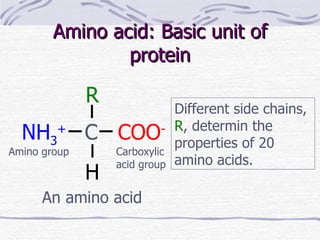
Amino acid: Basic unit of protein An amino acid Different side chains,  R , determin the properties of 20 amino acids. Amino group Carboxylic  acid group COO - NH 3 + C R H
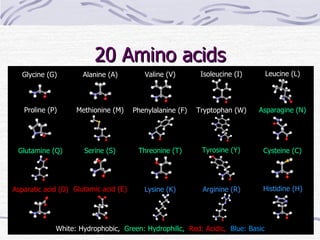
20 Amino acids Glycine (G) Glutamic acid (E) Asparatic acid (D) Methionine (M) Threonine (T) Serine (S) Glutamine (Q) Asparagine (N) Tryptophan (W) Phenylalanine (F) Cysteine (C) Proline (P) Leucine (L) Isoleucine (I) Valine (V) Alanine (A) Histidine (H) Lysine (K) Tyrosine (Y) Arginine (R) White: Hydrophobic,   Green: Hydrophilic,   Red: Acidic,   Blue: Basic
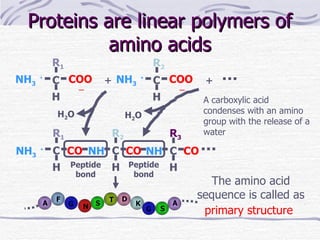
Proteins are linear polymers of amino acids R 1 NH 3 + C CO H R 2 NH C CO H R 3 NH C CO H R 2 NH 3 + C COO ー H + R 1 NH 3 + C COO ー H + H 2 O H 2 O Peptide bond Peptide bond The amino acid sequence is called as  primary structure   A A F N G G S T S D K A carboxylic acid condenses with an amino group with the release of a water
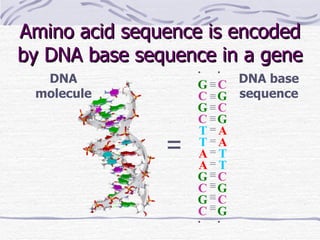
Amino acid sequence is encoded by DNA base sequence in a gene DNA molecule = DNA base sequence ・ C G C G A A T T C G C G ・ ・ G C G C T T A A G C G C ・
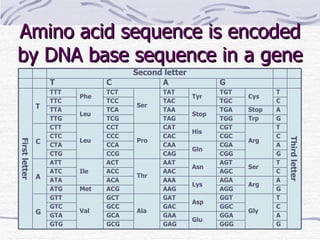
Amino acid sequence is encoded by DNA base sequence in a gene Second letter T C A G First letter T TTT Phe TCT Ser TAT Tyr TGT Cys T Third letter TTC TCC TAC TGC C TTA Leu TCA TAA Stop TGA Stop A TTG TCG TAG TGG Trp G C CTT Leu CCT Pro CAT His CGT Arg T CTC CCC CAC CGC C CTA CCA CAA Gln CGA A CTG CCG CAG CGG G A ATT Ile ACT Thr AAT Asn AGT Ser T ATC ACC AAC AGC C ATA ACA AAA Lys AGA Arg A ATG Met ACG AAG AGG G G GTT Val GCT Ala GAT Asp GGT Gly T GTC GCC GAC GGC C GTA GCA GAA Glu GGA A GTG GCG GAG GGG G
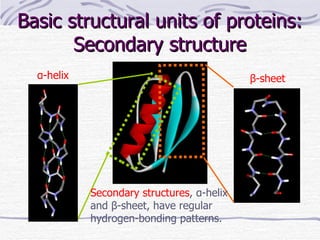
Basic structural units of proteins: Secondary structure α -helix β -sheet Secondary structures , α -helix and  β -sheet, have regular hydrogen-bonding patterns.
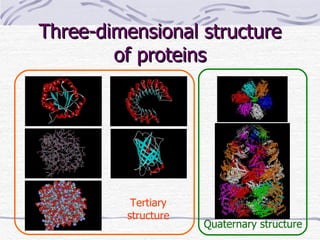
Three-dimensional structure of proteins Tertiary structure Quaternary structure
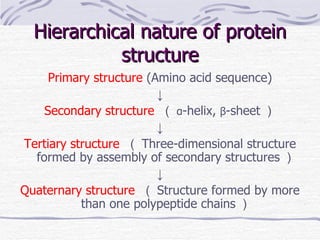
Hierarchical nature of protein structure Primary structure  (Amino acid sequence) ↓ Secondary structure  ( α -helix,  β -sheet ) ↓ Tertiary structure  ( Three-dimensional structure formed by assembly of secondary structures ) ↓ Quaternary structure  ( Structure formed by more than one polypeptide chains )

Chon structures 2

  • 1.
  • 2.
    FUNCTIONS Proteins functionas: 1. Enzymes:biological catalysts 2. Regulators of catalysis-hormones 3. Transport and store i.e. O2, metal ions sugars, lipids, etc.
  • 3.
    FUNCTIONS 4. Contractileassemblies Muscle fibers 5. Sensory Rhodopsin nerve proteins 6. Cellular defense (antibodies/Ig) 7. Structural (collagen)
  • 4.
    Proteins play keyroles in a living system examples of protein functions Catalysis: Almost all chemical reactions in a living cell are catalyzed by protein enzymes. Transport: Some proteins transports various substances, such as oxygen, ions, and so on. Information transfer: For example, hormones. Alcohol dehydrogenase oxidizes alcohols to aldehydes or ketones Hemoglobin carries oxygen Insulin controls the amount of sugar in the blood
  • 5.
    Amino acid: Basicunit of protein An amino acid Different side chains, R , determin the properties of 20 amino acids. Amino group Carboxylic acid group COO - NH 3 + C R H
  • 6.
    20 Amino acidsGlycine (G) Glutamic acid (E) Asparatic acid (D) Methionine (M) Threonine (T) Serine (S) Glutamine (Q) Asparagine (N) Tryptophan (W) Phenylalanine (F) Cysteine (C) Proline (P) Leucine (L) Isoleucine (I) Valine (V) Alanine (A) Histidine (H) Lysine (K) Tyrosine (Y) Arginine (R) White: Hydrophobic, Green: Hydrophilic, Red: Acidic, Blue: Basic
  • 7.
    Proteins are linearpolymers of amino acids R 1 NH 3 + C CO H R 2 NH C CO H R 3 NH C CO H R 2 NH 3 + C COO ー H + R 1 NH 3 + C COO ー H + H 2 O H 2 O Peptide bond Peptide bond The amino acid sequence is called as primary structure A A F N G G S T S D K A carboxylic acid condenses with an amino group with the release of a water
  • 8.
    Amino acid sequenceis encoded by DNA base sequence in a gene DNA molecule = DNA base sequence ・ C G C G A A T T C G C G ・ ・ G C G C T T A A G C G C ・
  • 9.
    Amino acid sequenceis encoded by DNA base sequence in a gene Second letter T C A G First letter T TTT Phe TCT Ser TAT Tyr TGT Cys T Third letter TTC TCC TAC TGC C TTA Leu TCA TAA Stop TGA Stop A TTG TCG TAG TGG Trp G C CTT Leu CCT Pro CAT His CGT Arg T CTC CCC CAC CGC C CTA CCA CAA Gln CGA A CTG CCG CAG CGG G A ATT Ile ACT Thr AAT Asn AGT Ser T ATC ACC AAC AGC C ATA ACA AAA Lys AGA Arg A ATG Met ACG AAG AGG G G GTT Val GCT Ala GAT Asp GGT Gly T GTC GCC GAC GGC C GTA GCA GAA Glu GGA A GTG GCG GAG GGG G
  • 10.
    Basic structural unitsof proteins: Secondary structure α -helix β -sheet Secondary structures , α -helix and β -sheet, have regular hydrogen-bonding patterns.
  • 11.
    Three-dimensional structure ofproteins Tertiary structure Quaternary structure
  • 12.
    Hierarchical nature ofprotein structure Primary structure (Amino acid sequence) ↓ Secondary structure ( α -helix, β -sheet ) ↓ Tertiary structure ( Three-dimensional structure formed by assembly of secondary structures ) ↓ Quaternary structure ( Structure formed by more than one polypeptide chains )